Crossfire Loop: You Are the Bottleneck
Software engineering used to operate at a slower pace. Difficult architectural decisions were followed by an extended period of implementation and testing. AI is taking over the implementation and testing. Now the job of a software engineer is only the difficult parts, condensed into a non-stop, mentally taxing stream.
You are the bottleneck.
Human intellect is still required for any serious engineering task, and it is the scarcest resource. Scaling means minimizing human involvement to only what is absolutely essential.
The Crossfire Loop is the agentic engineering solution we use at Sōnami. A panel of different AI models reviews the work. The models attack each other's findings and work together to push the work as far as it can go before a human ever looks at it.
Different Models, Different Blind Spots
Every model has strengths and weaknesses. One model is good at finding race conditions, another notices a missing test, and a third reads the spec more closely. When one model reviews its own work, it misses the same things it missed while writing.
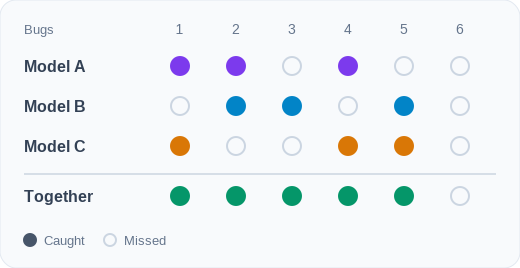
Their blind spots differ, so a panel from different model families catches more. That has a cost. A panel uses several times the tokens of a single reviewer.
The Loop
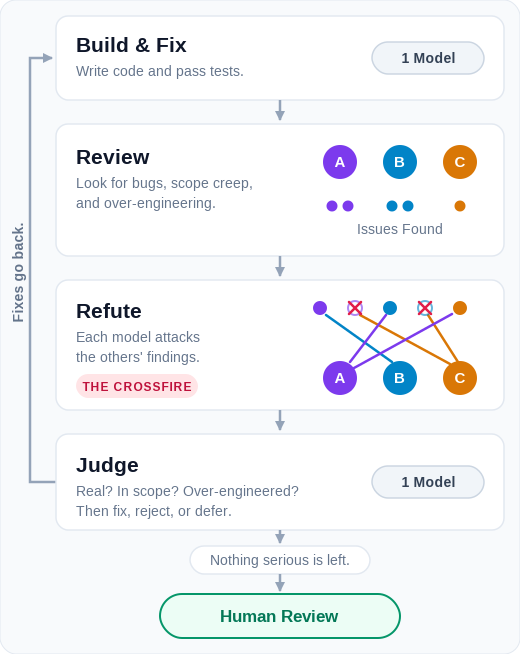
- Build. The implementer writes the change. Tests must pass before any review.
- Review. The panel reviews the change, each model with a fresh context. They look for bugs, scope creep, and over-engineering. Extra complexity counts as a defect.
- Refute. More reviewers also mean more false alarms. So the same panel tries to prove each finding wrong.
- Judge. One judge model checks each finding against the code. Is it real? Is it in scope? Is the proposed fix over-engineered? Then it rules: fix, reject, or defer. Deferred items go to human review.
- Fix. The implementer fixes each accepted issue and runs the tests again.
The loop repeats until a round finds nothing serious.
Who Builds, Who Reviews
The loop has two jobs, and they need different models. The implementer writes and fixes the code. It does most of the work, so it uses most of the tokens. It must be capable, but depending on the task, a premium model can be overkill. The panel reviews. Its models must be strong, and they must come from different companies, so their blind spots differ.
Implementers
| Work | Model |
|---|---|
| Most Issues | Most of the work is everyday features, bug fixes, and refactors. Use Claude Opus, GPT Sol, or Grok. Open-weight models also work well here: Kimi, GLM, DeepSeek, Qwen, MiniMax, etc. |
| Complex or Difficult Issues | Architecture changes and hard-to-find bugs need the strongest implementer. Use Claude Opus or GPT Sol. |
| UI and Visual Work | Use Claude Opus. |
| Long-Form Writing | This includes blog posts and page content. Use Claude Opus. |
| Small, Non-Functional Fixes | Labels, comments, and typos need little skill. Use a smaller model, such as GPT Luna or Claude Sonnet. |
Panel
A normal panel has three seats: one each from Anthropic, OpenAI, and SpaceXAI. One seat goes to a premium model. A hard problem gets all five.
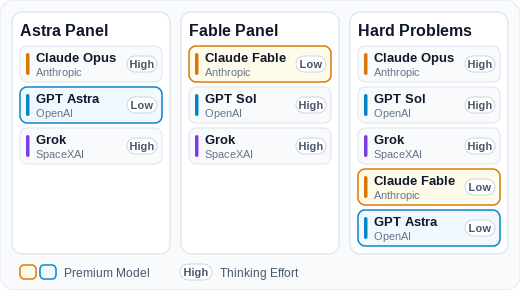
Premium models are stronger but cost much more, so they run at low effort. Even at low effort, they offer significant benefit because their baseline knowledge is much higher. The other models run at high effort. If the panel still disagrees after three rounds, another premium model joins the debate to break the tie. If the disagreement survives that, it goes to human review.
Why not only premium models? Premium models are the strongest, so one premium model, or a panel of only premium models, seems like enough. Testing shows otherwise. The lighter models still sometimes catch issues that the premium models miss, often enough to earn their seats.
Why these three companies? Open-weight models from Chinese labs add little to a panel. On reviews and hard problems, they rarely find anything that the OpenAI, Anthropic, and SpaceXAI models have not already found. This may be because they were distilled from models produced by these three frontier companies.
Not Just Code
The same loop works for design. One model drafts a plan, a design, or a recommendation. The panel attacks it and works toward the best version. The draft reaches a human only once nothing serious is left. The next chart started this way. Three models each proposed a design, then debated the best approach until they agreed unanimously.
What Reaches Human Review
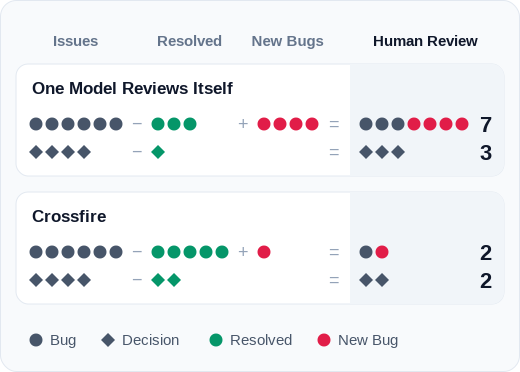
The last column is what goes to human review. Crossfire cannot resolve everything, but the combined panel leaves far less behind. Humans still set the project direction and make the difficult decisions. Most other issues are resolved before the work reaches them.
Counting the Real Cost
Crossfire is more expensive than the usual method, where one model writes the code and a human reviews every change. Running multiple frontier models on every change means paying for multiple subscriptions, and that cost adds up fast. But the cost is a tradeoff. In return, you get fewer bugs and better code, and you move significantly faster.
An engineer's time costs more than subscriptions. At Sōnami, the loop removes many days of unnecessary review each month for every engineer. Put a price on those days, and the subscriptions look small. In most cases, the extra cost is easily justified.
You are still the bottleneck. Crossfire makes sure your time is used only for the work that actually needs you.
The subscriptions cost money. The reviews you never have to do are worth more.