Q-Day: A Worst-Case Analysis of Crypto Agility
Cryptography has a finite lifespan. Merkle-Hellman, DES, GGH, SFLASH, MD5, A5/1, RC4, SHA-1, Rainbow, and SIKE were all trusted, and all broken. This is normal. Now AI is speeding it up. Claude Mythos Preview found a new attack on HAWK, and the Ethereum Foundation calls AI "a more urgent risk" than quantum computers.
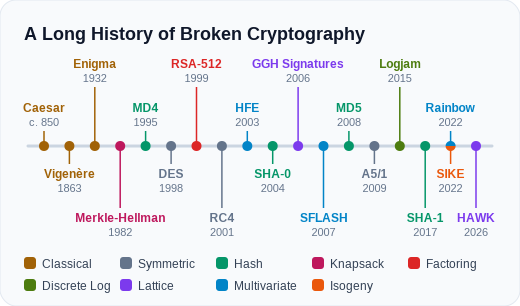
Picture the worst case. A whole class of algorithms breaks at once. Call it Q-Day, whether quantum computers or AI get there first. Reports of drained wallets pour in. You can do nothing, because blockchains all need a hard fork to change their cryptography. You are powerless, waiting for others to save you.
CKB is the only blockchain that's different. The lock that controls your address is just a smart contract. Anyone can deploy a new one and move their funds to it, with no fork and no vote.
So let's run a drill. What can one person with an AI account do on Q-Day?
The Drill
The goal is simple: build a brand new lock, with signature schemes that no other blockchain uses, and prove it works on a live network.
We choose two post-quantum schemes from unrelated classes, HAETAE-5 and QR-UOV, then let AI take over. In only 1 hour, 8 minutes, and 48 seconds, it writes the lock, tests it, deploys it, and sends real transactions.
In about an hour, two brand new signature schemes are live on a public network.
We go one step further with formal verification of the lock's core rules, which takes another 2 hours and 18 minutes. A panel of different models then reviews the code and signs off.
Why Two Signatures
Post-quantum math is young, and many schemes have already fallen. Our lock opens only when both signatures are valid.
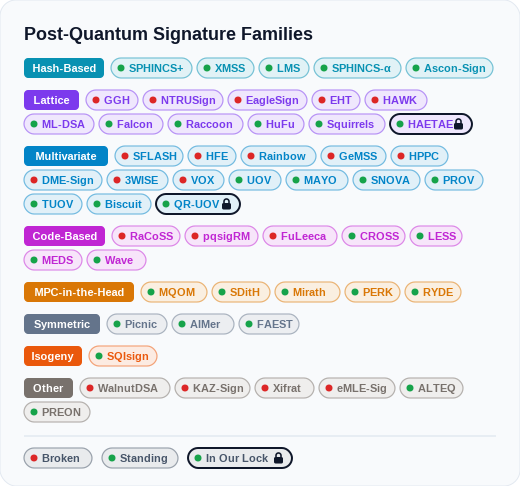
- HAETAE-5 is a lattice scheme that won the Korean post-quantum competition (KpqC).
- QR-UOV is a multivariate scheme in round 3 of NIST's additional signature process.
If one family falls, the other still guards the funds.
The Proof Is On-Chain
The lock is deployed on the CKB testnet, and the source code is public. These transactions come from four test wallets:
| Example | Transaction | What It Shows |
|---|---|---|
| Basic Transfer | 0x566b9adc…ebba8d |
Alice pays 500 CKB to Carol. |
| Basic Transfer | 0xe9820479…5b5951 |
Carol spends the cell she received from Alice. |
| Several Inputs, One Address | 0x81597bd4…0ffcca |
Alice spends 3 cells with one pair of signatures. |
| Several Inputs, One Address | 0x1b417dcb…8dbd1f |
Dave spends 3 cells with one pair of signatures. |
| Two Hybrid Addresses | 0xa1486b2b…1d1bb9 |
Bob and Carol sign together. |
| Two Hybrid Addresses | 0xc9788d7c…58c8b4 |
Alice and Dave sign together. |
| Mixed with secp256k1 | 0x85b47c2d…5c1b0e |
Bob's hybrid input pays with a secp256k1 input. |
| Mixed with secp256k1 | 0x2dbf0ddf…2731b3 |
The same mix in the other order, with Carol. |
Each spend has a transaction fee of less than a millionth of a dollar at the current exchange rate.
This Is Only a Drill... For Now
The rate of AI discoveries is accelerating, and it's rewriting our understanding of math and computing. Some of our major pillars will fall.
This is just a test. We would not use this lock on real funds today. It exists to prove what is possible.
AI still makes mistakes. Human review matters for anything secure. However, the writing is on the wall.
AI is quickly becoming the normal way to write code. Soon it will write code better than any human, and the formality of human code review will eventually disappear entirely.
If a crisis arises, the power to act for yourself and stand apart becomes your strongest asset. Attackers want the biggest payout, so they naturally take aim at the majority. Using your own custom lock moves you out of their crosshairs.
Today, it's a drill. On Q-Day, it's how you save yourself.